#AlbarinoDay #WorldAlbarinoDay
Albariño is a grape variety that has propelled itself to the forefront of the public’s wine-drinking consciousness in recent years. This is in no small part thanks to the variety’s accessibility, with its rich citrus and stone fruit aromatics and refreshing, peppy palate proving a suitable likeness to more familiar staples such as Sauvignon Blanc, whose ubiquity (and arguably, degree of sameness) has led inquisitive drinkers to look elsewhere for new and exciting alternatives. Additionally, commentators often attribute the proliferation of tapas culture into our dining scene to the gradual, increasing appearance of Albariño (an Iberian grape) onto our shelves – serendipitous, given its proclivity for pairing to fish and shellfish, a particularly useful quality given that we’re never too far from the coast or great seafood in these Isles. But what exactly is Albariño’s story – and where should one look to in order to find the best examples of the variety?
Albariño is an old grape variety, thought to have been brought to the Iberian Peninsula by monks in the 12th century. Theorised to be a close relative of Petit Manseng and with a lineage hailing back to Middle-Ages France, today the grape’s classical home is considered to be Galicia (in northwest Spain) and northern Portugal. Here the variety is instrumental in the production of Rías Baixas DO and Vinho Verde DOC wines, respectively. Broadly, on the Spanish side of the border, the wines tend to be taut and mineral, with zesty aromas and lemon-lime flavours, whereas in Portugal the wines exhibit peachier, more floral aromas and broader, richer flavours – yet what marries both expressions of the variety is that they possess a common thread of fresh, zippy acidity and a wholly Atlantic, sea-breeze-tinged piquancy, often described as a salty finish. In both cases, Albariño has shown itself to be a true ‘vin de terroir’, i.e., capable of showing the subtle differences between place and site that all great wines of the world strive to do, and it’s because of this that plantings of the grape have begun to expand into other winegrowing regions of the world.
Burgeoning outcrops of Albariño include forays further south into Portugal and Spain, as well as into the dynamic and consumer-led Pays D’Oc appellation of southern France, but most notably plantings have begun to take root in winegrowing regions spanning both new continents and hemispheres, with significant holdings now recorded in the USA, South America, South Africa, and New Zealand. In these areas, winemakers strive to make the clean, fresh wine styles that global consumers increasingly crave; marrying ripeness of fruit with a brisk acidity that is seemingly retained no matter where in the world the variety is grown. Additionally, producers are experimenting with different vinification and maturation techniques, including extended ageing of the wine on lees and maturation in oak barrels - all to improve body, texture and bolster complexity and age worthiness in the resulting wines of this increasingly desirable variety. Whatever form in which you wish to enjoy the wine, or if indeed you’ve yet to try it under any guise, rest assured that these wines almost always represent excellent value for money, and it is two such examples below that we wish to celebrate this World Albariño Day!
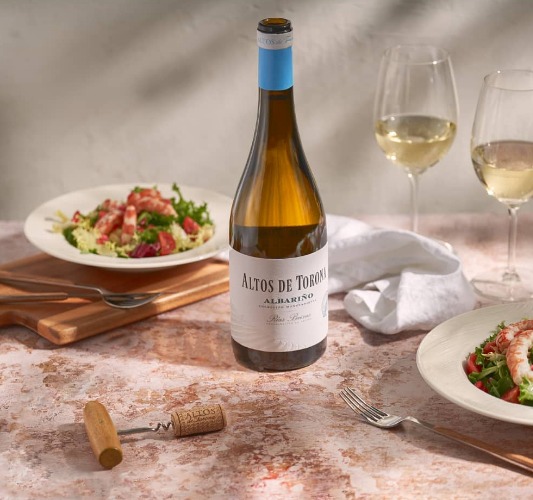
Altos de Torona Albariño 2021
Founded in 2000, Altos de Torona is a winery based in the southerly O Rosal subregion of Rías Baixas. Their 100 hectares of vines makes Altos do Torona the largest single estate in the region, planted mostly on the hillsides of the Monte Galeno and farmed using organic principles and a deep commitment to local biodiversity. This, their 2021 single varietal Albariño, is made up of vines grown on sandy, granitic soils which give an intense bouquet and aromatic complexity of spiced nectarine, lime blossom and smoky, mineral nuances. Steel-fermented and aged for 6 months on its lees before release, the result is a wine of taut lemon and pink grapefruit flavours alongside a breezy acidity, counteracted by a breadth of peachy fruit and fresh pastry on the unctuous mouthfeel. Finishing with the textbook Galician saline kick, this is a wine utterly borne of its Atlantic roots. Equally stunning as an aperitif, this wine is ideally served alongside steamed mussels, prawn linguine or classic fish and chips.
Awarded 96 points - Gold Medal & Spanish Trophy Medal at the International Wine Challenge 2022
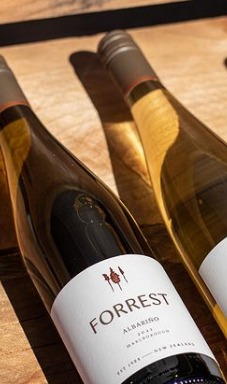
Forrest Estate Albariño 2021
Drs John and Brigid Forrest have been crafting wines in the Marlborough region of New Zealand since the late 1980s. They decided to plant Albariño in their hottest site, as the assured ripeness of fruit counteracted by cool ocean breezes in this coastal portion of the South Island provided an analogous terroir to that of the grape’s traditional home on the Atlantic coast of northwest Iberia. The more intense and longer hours of sunlight at these extreme southerly latitudes are evident from the aromas alone, with intense apricot, orange blossom and conference pear abounding on the nose. The palate is much fuller and fruitier than that of its Iberian counterparts, with generous honeydew melon flavours filling each sip, yet a streak of limey acidity and prickle of sherbet on the finish keep things linear and mouth-watering as the variety intended. Beautiful when served alongside seafood, naturally, this New World expression will also stand up well to chicken, pork and spicy or aromatic dishes – think Thai or Japanese cuisine.
Awarded 90 points – Raymond Chan Wine Reviews
